


I Refused to Kill the French Bees—So I Tried Talking to Them Instead
By sharing, you're not just spreading words - you’re spreading understanding and connection to those who need it most. Plus, I like it when people read my stuff.
There are certain things nobody tells you before you open a restaurant.
They tell you about food costs.
They tell you about payroll.
They tell you that employees will call out at the worst possible time, equipment will break five minutes before the dinner rush, customers will occasionally complain about things you cannot control, and the air conditioner will always seem to know exactly when you have no money available for repairs.
They do not tell you that one day you may find yourself standing behind the restaurant trying to negotiate a peaceful relocation agreement with a group of bees.
That part apparently comes later.
I have said many sentences during the years I have owned businesses that I never expected to say.
“Why is root beer dripping out of the ceiling?” was one of them.
“Who left the ceiling tile out under the air-conditioning return?” was another.
“Please close the kitchen door because we are not trying to air-condition the entire state of Georgia” is one I have said so many times that it no longer sounds unusual.
Recently, I added another sentence to the list.
“I am going outside to talk to the French bees.”
I said it seriously.
Everyone else looked at me as if the restaurant had finally caused whatever small amount of sanity I had left to disappear.
That may still be true, but talking to the bees seemed much more reasonable than killing them.
The bees began appearing behind the restaurant.
At first there were only a few of them. Nobody paid much attention. There are always insects outside a restaurant. There are flies, mosquitoes, moths, wasps, spiders, ants, and every other creature in Georgia that has decided restaurants are built primarily for their convenience.
Then more bees appeared.
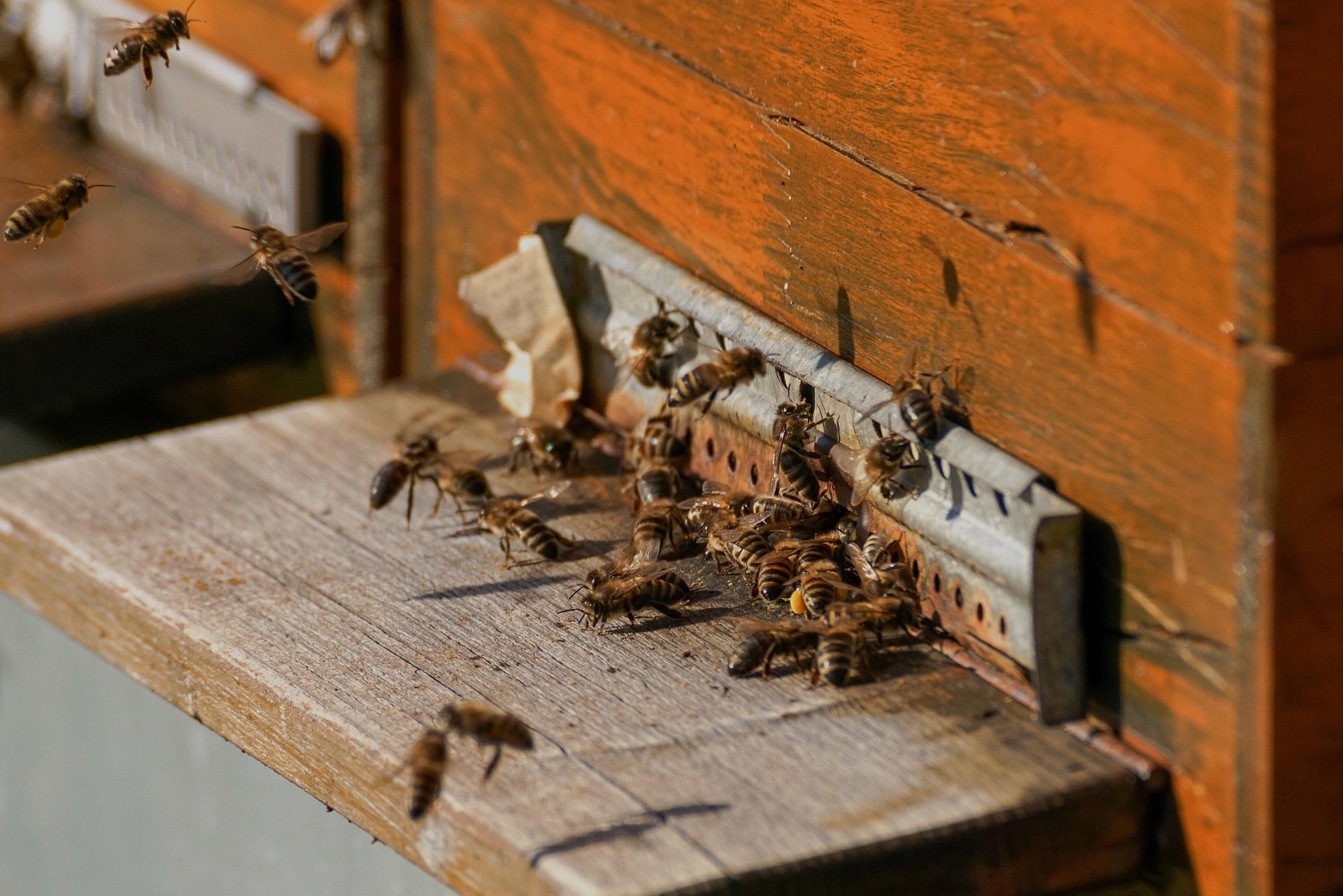
They were small and surprisingly calm. They flew around near the back of the building, landed on different surfaces, and seemed interested in whatever was back there.
My wife told me they were French bees.
I had never heard of French bees before.
I did not know whether that was their formal name, a common name, a nickname, or something she had heard from someone else. I did not argue with her about it because there was no reason to. She said they were French bees, so from that moment forward, that is what they became.
The French bees.
More specifically, they became my little French bees.
I did not invent the name. My wife identified them that way. I simply accepted it and began speaking to them accordingly.
Naturally, once I believed they were French, I began wondering whether they understood English.
That could have explained why they ignored every instruction I gave them.
They Were Not Aggressive
I watched them carefully.
I did not simply assume they were harmless because they were small. Small things can still cause large problems. Anyone who has ever had a tiny leak destroy a ceiling, a small computer error shut down a business system, or one drop of syrup find its way into an air-conditioning plenum understands that size does not always matter.
But these bees did not act aggressively.
They did not swarm around my face.
They did not chase me.
They did not repeatedly fly into people as though defending a nest.
They did not seem angry.
They were mostly busy doing whatever French bees do during the day.
Sometimes one of them would land on me.
It might land on my shirt, my arm, or my hand. It would sit there for a while and sometimes walk around as though it was inspecting me.
I did not slap it.
I did not panic.
I did not begin waving my arms.
I simply watched it.
The bee would eventually fly away.
That seemed like a perfectly successful encounter to me.
The employee standing twenty feet away, however, would react as if I had allowed a rattlesnake to crawl into my sleeve.
I would say, “It is not bothering me.”
The employee would say, “It is going to sting you.”
I would point out that it was currently sitting on me and not stinging me.
That argument made no difference.
The fact that I was not being stung did not prove the bee was harmless. Apparently, it proved the bee was waiting for the correct moment.
Employees and Bees Do Not Mix
One employee would see a bee and immediately move away.
Another employee would see the first employee moving away and assume something terrible had happened.
Then someone would yell, “There is a bee!”
Within seconds, the entire back of the restaurant would become a restricted area.
It did not matter whether there was one bee or twenty bees. Once someone said the word “bee,” the reaction was the same.
Some people are genuinely terrified of bees.
I understand that.
Some people have been stung badly. Some are allergic. Some have never spent enough time around bees to know the difference between a calm bee gathering food and an aggressive insect defending a nest.
Fear is real even when the danger is not.
I was not trying to make fun of anyone for being scared. I also could not allow fear alone to determine what happened next.
There is a dangerous habit people have when they are frightened.
They want whatever frightens them destroyed immediately.
They do not want to identify it.
They do not want to observe it.
They do not want to understand why it is there.
They simply want someone to spray it, smash it, trap it, remove it, or kill it.
Sometimes that response is necessary.
Sometimes there is an immediate danger.
But sometimes the thing everyone fears is just a little bee sitting on my shirt.
The First Solution Was Poison
Once enough employees became concerned, pest control entered the conversation.
That is the normal reaction in a restaurant.
You see an insect.
You call someone who owns chemicals.
The pest-control company called me back, and everyone began discussing spraying the bees.
I immediately said no.
“You are not spraying them.”
I did not need to think about it.
I did not need to hold a meeting.
I did not need three estimates.
I was not going to authorize someone to kill a group of bees that had not harmed anyone.
That does not mean I wanted them to remain behind the restaurant forever.
Bees and restaurants are not an ideal combination.
Customers generally do not want bees flying around while they eat.
Employees should not have to wonder whether an insect will land on them while they carry hot food.
We cannot allow bees to enter the kitchen, dining room, storage areas, coolers, or food-preparation spaces.
Those are legitimate concerns.
But legitimate concern does not make every possible response legitimate.
Spraying them was the easiest answer.
It was not necessarily the correct answer.
Killing Them Would Not Solve the Real Problem
The bees were there for a reason.
They had not randomly selected my restaurant from a list of local businesses.
Something attracted them.
Restaurants have plenty of things that attract insects.
Sugar.
Soda.
Fruit.
Trash.
Water.
Food residue.
Sweet-smelling cleaning products.
Leaks.
Dumpsters.
Open doors.
Sticky floors.
Employees who place things outside and forget about them.
And recently, we had experienced what could only be described as a root beer catastrophe.
A syrup line had failed.
Root beer syrup ended up where root beer syrup should never be.
It became a mist.
The air-conditioning system helped move that sticky mist into places nobody would normally inspect for soda syrup.
It reached ceiling areas.
It reached equipment.
It reached surfaces that were never intended to be glazed with root beer.
For a while, it seemed as though the building itself had become sticky.
People began calling.
Inspectors called.
Contractors called.
Cleaning companies called.
Pest-control people called.
Everyone had an opinion.
Everyone had a price.
At one point, I received a cleanup estimate so large that I thought they were planning to demolish the restaurant, rebuild it, and name the new building after themselves.
Considering all of that sugar, the bees may have believed they had discovered paradise.
From a bee’s point of view, my restaurant may have looked like an all-inclusive resort.
Unlimited sugar.
Shelter.
Water.
Warmth.
A covered area.
And one strange man who allowed them to sit on him.
They probably told all their friends.
Spraying the Bees Could Have Made Things Worse
Suppose I had allowed someone to spray them.
The bees present that day might have died.
Then what?
If the sugar, syrup, moisture, or other attraction remained, more bees could arrive the next day.
Then we would spray those bees.
More might arrive after that.
We could keep killing bees while never correcting the reason they were gathering there.
That is not pest control.
That is repeated failure with chemicals.
The responsible solution begins by asking questions.
What kind of bees are they?
Where are they coming from?
Are they part of a hive?
Are they only gathering food?
Is there a nest inside the wall, roof, ceiling, or nearby tree?
Is something leaking?
Is trash being left uncovered?
Is syrup still present?
Are doors being left open?
Can the attraction be removed?
Can the bees be safely relocated?
Those questions require observation and patience.
Spraying requires neither.
That is one reason spraying is popular.
People prefer solutions that look immediate, even when they do not solve the actual problem.
I Like Bees
I have always liked animals that other people misunderstand.
I do not need every creature to behave like a pet before I respect it.
A bee does not have to let me hold it.
A spider does not have to perform tricks.
A snake does not have to wag its tail.
They are allowed to be what they are.
Bees are useful.
They pollinate plants.
They support the food system.
They move from flower to flower doing work most people never notice.
They are not flying around all day searching for humans to attack.
Most bees are busy.
They have places to go.
They have work to do.
They have responsibilities.
In that sense, they may be better employees than some people I have hired.
They show up.
They stay focused.
They do not spend half their shift staring at a telephone.
They do not call thirty minutes before work and announce that they cannot come because something unexpected happened for the sixth time that month.
They also do not ask me to repeat instructions I gave them five minutes earlier.
The French bees were calm, organized, and apparently self-motivated.
The main problem was that they had not filled out an application.
They Landed on Me
The more time I spent near them, the more comfortable they seemed.
One would land on my sleeve.
Another would land on my arm.
Sometimes one would remain there long enough for me to study it.
There is something interesting about looking closely at an animal most people only see while running away.
A bee is not a simple little flying dot.
It has structure.
It has texture.
It has tiny moving parts.
It has behaviors and reactions.
It is aware of what is around it.
It makes decisions.
It may not make decisions the way humans do, but it does not move randomly.
When one landed on me, I stayed still.
The bee explored for a moment.
Then it left.
I was not stung.
I was not attacked.
I was not chased across the parking lot.
We simply shared the same space for a little while.
The employees considered this evidence that I had lost all survival instinct.
I considered it evidence that the bees were not interested in harming me.
My Wife Was Not Suggesting We Adopt Them
Although my wife had identified them as French bees, that did not mean she wanted me to establish a French bee sanctuary behind the restaurant.
There is a difference between identifying something and inviting it to move in permanently.
I began thinking about whether the bees could be encouraged to live somewhere else on the property.
Maybe they could move farther away from the building.
Maybe there was an area where they could remain without frightening employees or bothering customers.
It sounded reasonable until I remembered that bees do not respect property boundaries.
I cannot explain to them that the dining area ends here and the approved bee area begins two hundred feet away.
I cannot install a sign that says:
FRENCH BEES ONLY PLEASE REMAIN BEYOND THIS POINT NO FLYING NEAR THE KITCHEN
Even if I wrote the sign in French, I doubt it would help.
Bees go where the food is.
They travel.
They search.
They follow scents.
They do not care which part of the property I have assigned to them.
Finding the Queen
I also thought about whether they could be relocated.
That raised another question.
Where was the queen?
I did not know whether these bees belonged to a nearby colony, whether they were a temporary swarm, whether they were individual foragers, or whether they had established a nest somewhere in or around the building.
A successful relocation may require finding the queen.
That is easy to say.
“Find the queen.”
It sounds like a simple task until you look at dozens or hundreds of moving bees and realize none of them is wearing a crown.
I could not ask them which one was in charge.
I tried.
Nobody answered.
Maybe the queen was far away.
Maybe she was inside a wall.
Maybe she was in a tree.
Maybe she was not present at all.
Maybe the bees behind the restaurant were simply workers gathering whatever sweet material they could find.
I needed better information before doing anything.
That meant photographs, video, observation, and possibly someone who knew more about bees than I did.
It did not mean spraying first and identifying the bodies later.
The Employees Wanted Certainty
Employees often want management to provide certainty.
They ask, “Are the bees dangerous?”
That sounds like a yes-or-no question.
It is not.
Almost anything can be dangerous under the wrong conditions.
A bee can sting.
A person can be allergic.
A frightened employee can swing a tray, fall, spill hot food, or injure someone while trying to escape.
A colony inside a wall can become a structural or sanitation concern.
A swarm can behave differently if threatened.
I could not honestly say there was zero risk.
I could say what I observed.
They had not acted aggressively.
They had landed on me without stinging.
They appeared interested in something near the building.
They were mostly outside.
Nobody had been injured.
That was the truth.
Some people do not like truthful answers when those answers include uncertainty.
They want someone to say either:
“There is absolutely no danger.”
Or:
“We are killing them immediately.”
Reality often exists between those two statements.
Keeping the Door Closed
While we were discussing the bees, I returned to one of my most frequent restaurant instructions.
Keep the door closed.
This should not be difficult.
A door has a very limited number of jobs.
It opens.
It closes.
It occasionally locks.
That is nearly the entire job description.
Yet restaurant doors are apparently among the most misunderstood pieces of equipment in existence.
An employee will prop the kitchen door open in the middle of a Georgia summer.
Then someone will complain that the kitchen is hot.
The air conditioner will struggle.
Humidity will enter the building.
Vents may begin sweating.
Insects will fly inside.
Then everyone will begin investigating the mysterious causes of the heat, humidity, condensation, and insects.
The cause is the open door.
I explain this.
They agree.
Then someone opens it again.
With French bees gathering outside, keeping the door closed became even more important.
I did not want the bees inside.
I also did not want employees swinging objects at them near food.
The bees could remain outdoors while we determined what was attracting them and how to remove it.
The door could help maintain that boundary.
But only if it was closed.
I Went Outside to Speak With Them
Since everyone else had already offered their solution, I decided to try mine.
I went outside.
The French bees were flying around behind the restaurant.
One landed on me.
I looked at it and began explaining the situation.
I told it that my wife had identified it as a French bee.
The bee did not confirm or deny that information.
I told it that I personally had no problem with it.
I explained that I liked bees.
I explained that I appreciated the fact that none of them had stung me.
Then I explained the business problem.
The employees were frightened.
Pest control wanted to spray.
Customers might become concerned.
The bees could not enter the building.
They could not continue gathering directly behind the restaurant.
I told the bee that I was trying to protect it, but I needed cooperation.
The bee walked across my shirt.
I took that as acknowledgment.
Then it flew away.
I hoped it was returning to the others with my message.
A few moments later, another bee landed on me.
Apparently, communication within the colony needed improvement.
Maybe I Needed to Speak French
It occurred to me that I was addressing French bees in English.
That may have been the problem.
I do not speak French.
My wife does.
Perhaps she needed to conduct the negotiations.
She was the one who knew they were French bees in the first place.
Maybe they would listen to her.
I considered using a translation application.
I could type:
“Please move away from the restaurant. The employees are frightened, and pest control is threatening military action.”
Then I could play the translated message near the bees.
I did not do that.
Not because it was ridiculous.
The entire situation was already ridiculous.
I simply did not believe a telephone speaker would improve the negotiations.
Still, it would have made an interesting video.
A grown man standing behind a restaurant while his telephone politely asks bees in French to relocate.
That may have been the moment the employees stopped worrying about the bees and began worrying about me.
I Tried to Explain the Consequences
On my next visit outside, I became more direct.
I told the French bees they were in danger.
I explained that not everyone felt the way I did.
I told them that some people saw an insect and immediately wanted poison.
I told them I had prevented pest control from spraying them, but I could not guarantee someone would not panic when I was away.
They needed to move.
Not because I hated them.
Not because they had done anything wrong.
They needed to move because they had selected a location where fear, food regulations, employees, and business concerns made peaceful coexistence difficult.
One bee sat on my arm while I explained all of this.
It seemed to listen.
Then it cleaned itself.
I am not certain it understood the urgency.
The Restaurant Had Already Been Through Enough
The timing was terrible.
The restaurant had already experienced enough problems.
The syrup disaster alone had turned normal operations into chaos.
People were worried about contamination.
Cleaning had to be discussed.
Equipment had to be checked.
The ceiling area had to be considered.
The air-conditioning system had become part of the problem.
There were calls from inspectors, contractors, and companies offering solutions that cost more than I had available.
Then the bees appeared.
From their perspective, they probably arrived at the perfect time.
From my perspective, they joined a very long line of things requiring immediate attention.
That is how restaurants work.
Problems do not wait politely for previous problems to be solved.
They pile on top of one another.
The air conditioner does not wait for the refrigerator repair.
The plumbing leak does not wait for payroll.
The employee does not wait for the dinner rush to call out.
The bees do not wait until the syrup has been completely cleaned.
Everything happens at once.
Then people look at the owner and ask what he is going to do.
Apparently, I was going to talk to the bees.
Restaurant Owners Become Everything
Owning a restaurant means becoming many things you never intended to become.
You become a plumber because something is leaking.
You become an electrician because something stopped turning on.
You become a refrigeration technician because a cooler is three degrees warmer than it should be.
You become a counselor because two employees are angry with each other.
You become a detective because food, money, equipment, or supplies have disappeared.
You become a trainer because someone does not understand a task you explained yesterday.
You become a weather expert because temperature and humidity affect everything.
You become a legal researcher because one customer, employee, vendor, or government agency has asked a question nobody can answer clearly.
You become an exterminator because something with more legs than expected has entered the building.
And occasionally, you become an international diplomat attempting to negotiate with French bees.
None of that appears in the business plan.
I Did Not Want Them Hurt
The simplest truth was that I did not want the bees killed.
They had not hurt me.
They had not hurt an employee.
They had not entered the food-preparation area.
They were outside, following a scent or food source.
They were doing what bees do.
I could not justify killing them merely because their presence was inconvenient.
I have always believed there should be a difference between inconvenience and danger.
People often treat them as the same thing.
A creature appears where we do not want it.
It becomes inconvenient.
We call it a pest.
Once we call it a pest, almost any treatment seems acceptable.
But the label describes our relationship with the animal, not the animal itself.
The bee does not know it is a pest.
It does not know it is behind a restaurant.
It does not know about health inspections, employee fears, customer complaints, or pest-control contracts.
It smells something useful and follows it.
That is all.
Removing the Attraction
The best answer was to remove whatever attracted them.
That meant cleaning.
Not ordinary cleaning.
Restaurant owners know that there are levels of cleaning.
There is wiping a counter.
There is mopping a floor.
There is cleaning underneath equipment.
There is pulling equipment away from walls and discovering substances that appear old enough to vote.
Then there is searching an entire area for invisible traces of syrup that bees can smell better than humans ever could.
Every sweet residue mattered.
Trash needed to remain covered.
Soda containers needed to be checked.
Leaks needed to be repaired.
The dumpster area needed to be clean.
Any standing water needed attention.
The back door needed to remain closed.
If the food source disappeared, the bees might eventually decide the restaurant was no longer worth visiting.
That would be better than killing them.
It would also reduce the chance of more bees arriving later.
Photographing the French Bees
I wanted photographs and video.
There were several reasons.
First, I wanted a better identification.
My wife said they were French bees, and I accepted that, but I still wanted to know more about them.
What kind of bee was commonly called a French bee?
Were they actually bees?
Were they a type of small honeybee?
Were they some other pollinating insect?
Were they hoverflies that resembled bees?
Were they gathering food or searching for a nesting site?
Clear photographs could help answer those questions.
Second, I wanted proof of their behavior.
I wanted people to see that they landed on me without attacking.
That might calm the employees.
Or it might convince them I was even crazier than they originally believed.
Either way, it would be evidence.
Third, I simply wanted a record of them.
I liked them.
Even though they needed to leave, I wanted to remember them.
Not every unusual event requires destruction.
Sometimes it deserves a photograph.
Friendly Does Not Mean Domesticated
I called them friendly because of how they behaved around me.
I understood they were not pets.
They did not know their names.
They did not come when called.
They did not recognize me as their owner.
I did not own them.
They were wild creatures.
Calling them friendly meant they tolerated my presence and did not behave aggressively.
That did not mean I should grab them, disturb a nest, block their path, or assume they could never sting.
Respect includes recognizing limits.
I could enjoy their company without pretending they were domesticated.
I could protect them without pretending they belonged inside a restaurant.
I could insist on humane treatment while still insisting they needed to move.
Those positions did not conflict.
Fear Spread Faster Than Facts
By the time everyone had discussed the bees, the story became larger than the actual situation.
That happens often.
One person sees three bees.
The next person hears there are ten.
Another person hears there is a swarm.
Then someone says there is a hive inside the building.
Soon the restaurant is apparently under siege.
Nobody intentionally lies.
The story grows because fear fills in missing information.
That is why observation matters.
How many bees were actually present?
Where were they?
What time did they appear?
What were they landing on?
Where did they fly afterward?
Did they enter a crack or opening?
Were they carrying pollen?
Were they aggressive?
Had anyone been stung?
Those details mattered more than the number of people who were frightened.
What I Told the Employees
I told the employees not to swing at the bees.
I told them to stay calm.
I told them to keep the door closed.
I told them to report where they saw the bees.
I told them not to spray random chemicals near the restaurant.
I told them pest control was not going to kill the bees simply because they were outside.
I also told them I was taking the problem seriously.
That part mattered.
When someone is afraid, saying “There is nothing to worry about” often makes the fear worse.
It sounds dismissive.
I could acknowledge the fear without agreeing that extermination was necessary.
Yes, bees can sting.
Yes, we needed to prevent them from entering.
Yes, we needed to identify where they were coming from.
Yes, someone allergic to bees should avoid the area.
No, we were not immediately poisoning them.
That was the policy.
I Wondered Whether They Recognized Me
After several visits, I began wondering whether the bees recognized me.
I do not know whether they did.
Maybe I smelled different from the employees.
Maybe I moved more slowly.
Maybe they reacted to the fact that I did not swat at them.
Maybe each bee landing on me was a different bee with no memory of previous encounters.
But it felt as though they had accepted me.
I could stand near them without causing alarm.
They could land on me without causing alarm.
We had reached a basic understanding.
I would not hurt them.
They would not hurt me.
The difficulty was convincing them to extend that agreement to the entire restaurant staff.
Talking to Animals
I talk to animals.
I have always done that.
I talk to dogs.
I talk to cats.
I talk to birds.
I talk to bees.
Sometimes animals respond more honestly than people.
A dog does not pretend to understand and then do the opposite for political reasons.
A cat does not schedule a meeting to discuss why it ignored you.
A bee does not give you a ten-minute explanation before refusing to answer a yes-or-no question.
Animals communicate differently, but they communicate.
They respond to movement, tone, posture, familiarity, and threat.
The French bees may not have understood my words, but they understood that I was not attacking them.
That was enough for a beginning.
The Final Negotiation
I went outside again.
The bees were still there.
One landed on my shirt.
I told it the situation had become serious.
I explained that I had defended the bees.
I had stopped pest control from spraying them.
I had tried to calm the employees.
I had considered relocation.
I had offered several reasonable alternatives.
The bees, meanwhile, had continued appearing behind the restaurant without submitting any formal response.
I told the bee that negotiations could not remain open forever.
It walked across my shirt.
I informed it that walking away from the issue was not productive.
It flew away.
I chose to interpret that as a promise to consult with the queen.
They Reminded Me of People
The bees made me think about how quickly people judge what they do not understand.
Someone sees a creature and becomes afraid.
Someone meets a person who thinks differently and becomes suspicious.
Someone hears an unfamiliar idea and rejects it before examining it.
Someone sees unusual confidence and calls it arrogance.
Someone sees knowledge they do not understand and assumes it must be fake.
Someone sees a bee and assumes it wants to sting.
Sometimes the judgment is correct.
Often it is not.
These bees were not monsters.
They were simply in the wrong place.
I know what that feels like.
I have spent much of my life in places where people did not understand me.
I have been told that something I knew could not possibly be known.
I have been accused of memorizing answers because someone could not understand how I reached them.
I have been treated like a problem because my mind did not work the way someone expected.
The bees had a similar problem.
They were behaving normally.
The people around them interpreted that behavior through fear.
The World Does Not Need More Unnecessary Killing
There is already enough destruction in the world.
People kill animals because they are afraid.
They kill them because they are inconvenient.
They kill them because removing them humanely requires extra effort.
They kill them because poison is faster than understanding.
Sometimes killing is unavoidable.
Food safety matters.
Public safety matters.
Dangerous infestations must be handled.
But “unavoidable” should mean unavoidable.
It should not mean the first person called happened to bring a spray tank.
These French bees deserved at least an attempt at a better solution.
Clean the attraction.
Observe their path.
Locate the hive if one exists.
Contact someone who relocates bees.
Seal the building.
Give them time to move on.
Those steps take more work.
Doing the right thing often does.
Then They Began to Leave
After a few days of cleaning, there were fewer bees.
At first, the difference was small.
Instead of seeing a large group flying around the back of the restaurant, I might see only a handful.
Then there were only two or three.
Then one.
We continued cleaning.
We removed the sugary residue.
We checked the area for anything sweet that might still be attracting them.
We kept the trash covered.
We tried to keep the door closed.
We took away the reason they had come.
The bees apparently noticed.
They did not leave all at once.
There was no dramatic moment when the queen announced that negotiations had concluded and the entire colony departed in formation.
They simply faded away over several days.
Each time I went outside, fewer of them were there.
Then one day, I went outside and there were none.
The French bees had left.
Nobody Had to Kill Them
Nobody sprayed them.
Nobody poisoned them.
Nobody knocked down a hive.
Nobody killed a queen.
Nobody had to turn the back of the restaurant into a chemical war zone.
We cleaned.
We removed the attraction.
We waited.
The bees left.
That was exactly what I had hoped would happen.
It proved the point I had been trying to make from the beginning.
The bees were not there because they had declared war on the restaurant.
They were there because they found something they wanted.
Once that something disappeared, they moved on.
Killing them would not have solved the actual problem.
If the syrup and sugar had remained, more insects could have arrived.
Spraying would have killed the bees we could see while leaving the reason they were there untouched.
Cleaning solved the real problem.
It took a few days instead of a few seconds, but nobody had to die.
That seemed like a good result.
Everyone Else Was Relieved
The employees were happy.
They could use the back door without first looking around for a bee.
Nobody was backing away from the building.
Nobody was waving trays through the air.
Nobody was asking when pest control was coming.
The crisis was over.
The bees were gone, the area was clean, and restaurant operations could return to normal—or whatever passes for normal in my restaurant.
Everyone else seemed relieved.
I was too.
Mostly.
Then I Realized I Missed Them
A few days later, I walked outside and instinctively looked for them.
There were no little bees flying around the back of the building.
None landed on my shirt.
None walked across my arm while I explained restaurant policy.
None sat quietly while I told them they needed to move.
The area felt strangely empty.
That surprised me.
I had spent days trying to convince them to leave.
I had explained the problem to them repeatedly.
I had cleaned away the reason they were there.
I had protected them from being sprayed and encouraged them to find somewhere safer.
Then they did exactly what I wanted.
And I missed them.
I missed seeing them flying around.
I missed having one land on me.
I missed talking to them, even though I knew they probably had no idea what I was saying.
For those few days, they had become part of my routine.
I would go outside, check on them, let one land on me, and explain the situation again.
They never argued.
They never interrupted.
They never gave me excuses.
They simply listened for a while and flew away.
That was more peaceful than most of the conversations I have during an ordinary restaurant day.
I Wonder Where They Went
I still wonder where they went.
I hope they found somewhere better.
I hope they found flowers instead of root beer syrup.
I hope they found a quiet place where nobody was frightened of them and nobody was standing nearby with a can of poison.
Maybe they returned to a hive a mile away.
Maybe they still fly past the restaurant occasionally, but there is no longer anything there to make them stop.
Maybe one of them will land on me again someday and I will recognize it, even though I know that is unlikely.
I like to imagine that they remember the strange man behind the restaurant who talked to them and refused to let anyone spray them.
They probably do not.
But I remember them.
The French Bees Became Part of the Restaurant’s Story
The French bees were only there for a few days, but they became part of the history of the restaurant.
They joined the list of things I never expected to deal with when I became a restaurant owner.
Broken air conditioners.
Dripping ceiling vents.
Open kitchen doors.
Root beer syrup in places no root beer syrup should ever reach.
Employees frightened by harmless little creatures.
Pest-control companies ready to spray first and ask questions later.
And one restaurant owner standing outside trying to negotiate with bees.
Most people would have seen them as a minor pest problem.
To me, they became visitors.
Unexpected visitors, certainly.
Visitors who could not stay.
But visitors nevertheless.
My Wife Was Right
My wife was the one who told me they were French bees.
I had never heard of them before she said it.
Once she identified them, that was what they became to me.
My little French bees.
I still do not know whether that is their official scientific name, a common nickname, or something my wife learned somewhere that I did not.
It does not matter now.
That is what I called them.
That is what they will always be in my memory.
When I think about them, I do not remember a dangerous swarm.
I remember small, calm bees landing on my arms and shirt.
I remember employees watching me from a safe distance as if I were handling explosives.
I remember telling pest control not to spray.
I remember going outside to talk to them.
And I remember the strange disappointment I felt when I finally realized they were gone.
Sometimes You Miss the Problem
That may be one of the stranger truths in life.
Sometimes a problem enters your life, disrupts everything for a while, and forces you to pay attention to something you would otherwise never have noticed.
You work to solve it.
You complain about it.
You tell it to leave.
Then it leaves, and you discover that part of you misses it.
I did not miss the employees being frightened.
I did not miss worrying about a bee getting inside.
I did not miss the possibility that someone would panic and get stung.
I missed the bees themselves.
They had done nothing wrong.
They were simply following the smell of sugar.
They found a temporary source of food, stayed for a few days, and moved on when it disappeared.
For them, it was probably an ordinary part of life.
For me, it became a story.
One Last Conversation
A few days after they left, I went outside and stood where they had gathered.
I looked around as if one of them might still appear.
None did.
I told them goodbye anyway.
I thanked them for leaving peacefully.
I told them I was glad nobody had sprayed them.
I told them I hoped they had found somewhere safe.
There was no bee sitting on my arm to hear me.
There was no tiny audience flying around behind the restaurant.
It was just me talking to an empty parking lot.
That probably looked even stranger than talking to the bees.
But I meant it.
I Hope They Come Back—Just Not to the Restaurant
I would like to see them again.
Not gathering around the kitchen door.
Not frightening the employees.
Not landing near food or creating another restaurant problem.
But somewhere else.
Maybe in a garden.
Maybe around flowers.
Maybe on the far side of the property where nobody needs to carry trays or pass a health inspection.
I hope one lands on me again someday.
I hope I can stand still, watch it walk across my hand, and remember the little French bees that briefly moved into my restaurant after the root beer disaster.
They arrived because of a mess.
They left because we cleaned it.
Nobody killed them.
Nobody was stung.
The restaurant survived.
It was the best possible ending.
I just did not expect the ending to make me sad.
For a few days, the French bees were my friends.
Then they moved on.
Now I miss them.
0 Comments